Does Your Dealership Website Have Model Inventory Pages?
Why self-canonical, permanent model pages matter for SEO and GEO, and how dealerships can build evergreen inventory pages that are actually indexable and rankable?


Adriana Dikih
SEO/GEO Researcher
SEO
/
Your website has two kinds of visitors.
The first kind is people. They open your site on a phone or a laptop, they see the pictures and the prices, and they tap the filters until they are looking at the vehicles they actually want.
The second kind is robots. They do not see any of that. They read the code underneath, and what they find there decides whether you show up in Google, in Bing, or in the answer ChatGPT gives someone shopping at eleven at night.
Dealership marketing teams are the first kind. So… most dealers only ever check the user experience of the first kind.
We know the user experience for the second, the robot kind. And it’s a core pillar of our SEO strategy.
What We Tested
We took the same task and ran it across the top dealer website platforms.
Open the new inventory page. Filter to one make and model, the way a shopper would. Then check whether the page you are now looking at exists as a real page as far as a search engine or LLM crawler is concerned.
Not whether it loads. Not whether it looks right. Whether a robot would treat it as a page worth ranking.
The Results
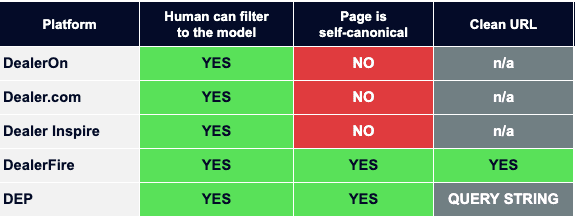
Look at the first column. Every platform passes. The filtering works, the page loads, the vehicles appear. Any GM checking this on their phone would conclude everything is fine. This is the experience of human users.
Now look at the second column. On three of the five, that page does not exist for robot users. And these users decide who ranks in search and LLM results. It’s kind of important to supply them with the content they need.
Nerd Alert: What "Self-Canonical" Means
Self-canonical essentially means there is a code snippet on the page telling bots that it is a valuable, standalone page, not simply a copy of another page.
When a page is not self-canonical, that snippet points somewhere else. It tells the search engine, in effect, ‘do not consider me’, consider that other page instead.
Here is a real example from the test. On one platform, we filtered the new inventory page down to a single model. The page loaded correctly and showed exactly the right vehicles. The code on that page told search engines to ignore it and look at the unfiltered inventory feed instead.
So the model page exists for human users and does not exist for robot users.
What this means for you: if a bot cannot see a page as a standalone page, it cannot rank that page. Not in Google, not in Bing, and not as a source in an AI answer. Your shopper found it by tapping filters. Nobody will ever find it by searching.
This Is Not Your CMS Platform Being Lazy
It would be easy to read that chart as three companies doing a bad job. That is not what is happening, and it is worth understanding why, because it changes what you should ask them for.
Filtered inventory creates an enormous number of combinations. Make, model, year, trim, color, body style, price band, mileage, drivetrain, and every one of those crossed with every other one. Open all of it to search engines and you generate tens of thousands of pages, most of them nearly identical, many of them empty the moment a vehicle sells.
That is a genuine problem. These pages would *mostly* be ignored, as it’s a dilution. With so many low value webpages, how do bots find the good ones?
So CMS platforms pick one of two settings. Either nothing filtered is open to search engines, or everything is. Almost nobody offers the middle, which is the only setting that would actually serve you.
What this means for you: Your filtered inventory page isn’t doing any work for you organic search or LLM search. It’s simply for humans.
The Two Yeses Are Not Equal
DealerFire produced a genuinely clean result. A permanent URL, readable, self-canonical, structured the way you would build it on purpose.
DEP passes too, but on a query string. The page is open to search engines, and that is the part that matters most. But a URL full of parameters is a weaker asset than a clean path. It is harder to link to, it looks worse in a search result, and parameter-based URLs are historically the first thing to get treated as disposable when a search engine decides to crawl less of your site.
What this means for you: indexable and rankable are two different bars. Clearing the first one does not clear the second.
What This Costs You
Here is the uncomfortable part. Most dealer websites do not have the pages their marketing teams think they have.
Ask most GMs whether their site has a page for the model they sell the most of, and they will say yes, because they have filtered it themselves and seen it with their own eyes.
On three of the five platforms we tested, that page is invisible to every search engine and every AI assistant on the internet.
That is not a small gap. Model-level searches are where the money is.
Somebody typing the name of a specific model plus your city is close to buying. If you have no page that can rank for that search, a third-party listing site will take it, and you will pay them for the lead you could have earned. That’s a miss.
The Fix: Build the Pages on Purpose
Because most of these platforms do not make filtered model pages available to search engines, your website team needs to create model-specific permanent URLs instead.
Depending on who you ask, these get called search results pages (SRPs) or vehicle listing pages (VLPs). Same thing either way. They are stand alone pages that show your current inventory for one model and have a bit of contextual content on the page.
They should be evergreen pages. No year in the URL. Simple structures like:
website.com/make-model-for-sale/website.com/new-make-model-for-sale/website.com/make-model-for-sale-city/
Each of those variations has nuance depending on your market, your competition, and what you already rank for. We are not going to tunnel on that nuance here.
The important part is that the page is permanent, self-canonical, and does not depend on anyone tapping a filter to exist.
What this means for you: you are not fighting your website platform. You are building alongside it. The filtered view keeps doing its job for shoppers who are already on your site. The evergreen page does the job of getting found in the search ecosystem.
Which Models Deserve a Page
Not all of them. A page for a model you stock twice a year is a page that sits empty most of the time, and an empty page is worse than no page.
The rule we use:
Every model you consistently have three or more units of gets its own new inventory search page. If it is reliably on your lot, it should be reliably in search.
High-end and exotic trims get one too, even at lower volume. Those searches are small, specific, and shoppers will drive for those models. Plus, almost nobody has built a page for them.
Everything else can stay in the filtered view where it belongs.
The Takeaway
Most dealer websites do not have the pages their marketing team thinks they have.
You can check this yourself in about a minute. Open your inventory page, filter to your best-selling model, then right-click and choose view page source. Search that code for the word "canonical." If the address you find there is not the address in your browser bar, that page does not exist for search engines.
Then decide whether you are comfortable with that, given how many people are out there searching for exactly that model.
Or, reach out to us and have us do it.