Google Kept Picking the Wrong Picture. So We Told It Which One To Use.
A Toyota dealership in Virginia that slants heavily on lease wanted focused efforts on increasing their search engine rankings for their model specific lease offers. We said yes.

The Results
0 → 114 | 58 | +89% |
clicks from Google Images | lease searches now ranking in the top 5 of Google Images | total clicks to the lease pages |
up from zero across the entire prior period | all of them starting from no ranking at all | 288 to 545 |
The Challenge
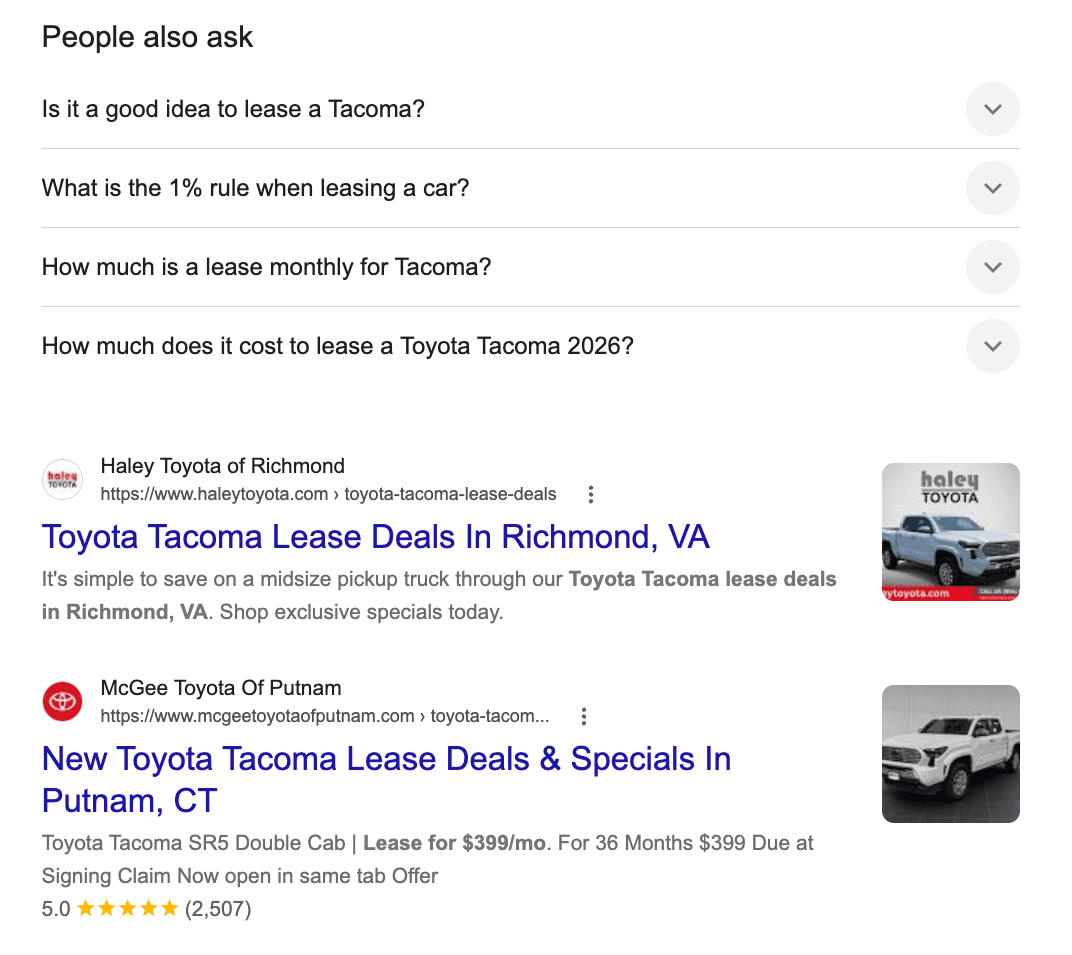
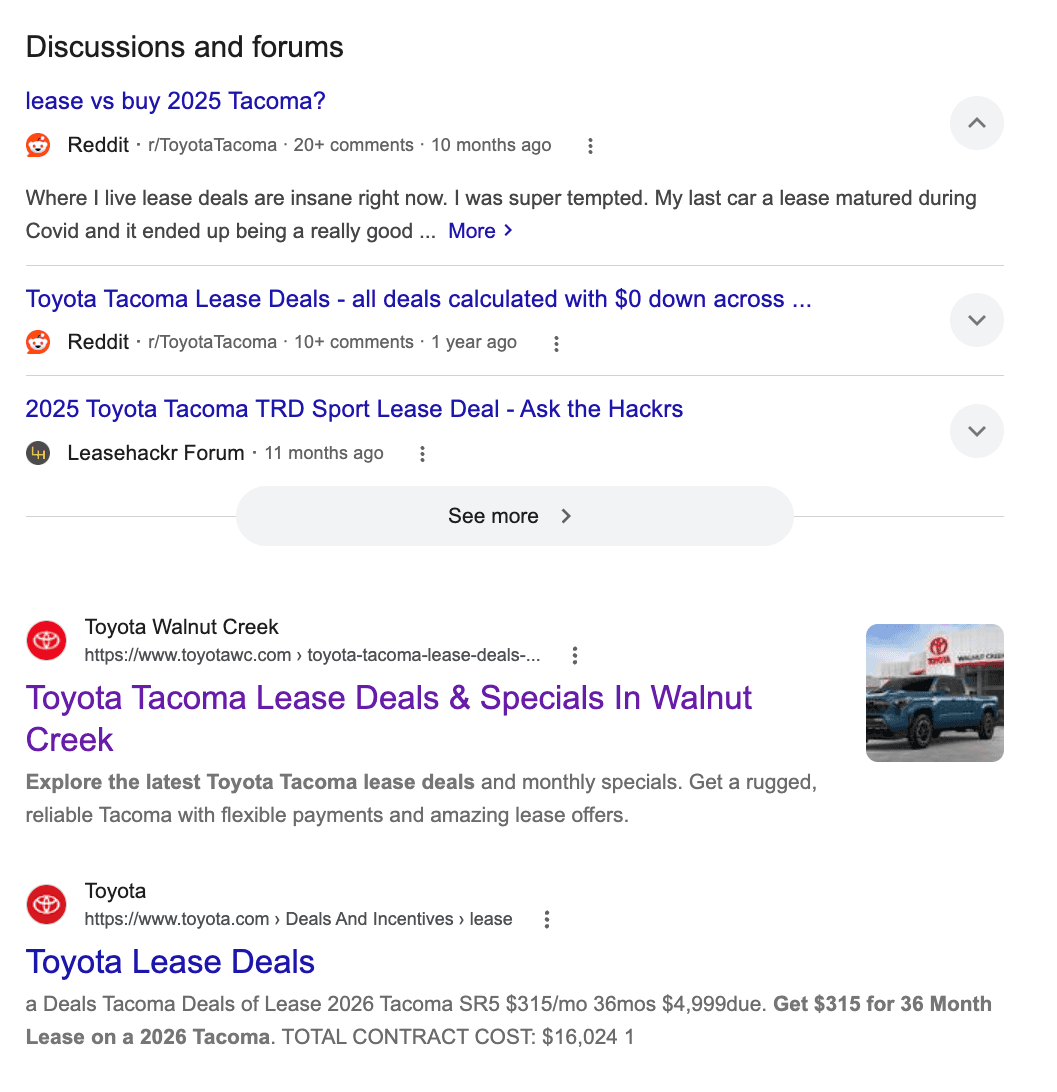
Google picks the picture. You can write the page, price the offer, and design a clean graphic with the payment right on it. Then Google shows a search result with a grainy inventory photo of some other car, cropped through the middle, with the text cut off.
This is normal in automotive, and most dealers never notice it. Your dealership website has hundreds of images on any given page. Many website providers wrap all of them in the same code, so nothing tells Google which one actually matters. Google guesses, and often it guesses badly.
On a phone, that guess is the largest thing in your listing. It is doing most of the persuading before anyone reads a word of your headline.
Our team had already built these lease pages in a different way. Instead of putting the offer in a text box, the payment, the term, and the money down all live on a designed image. Those pages ranked well from the day they launched, locally and sometimes nationally. But for about a year, the picture Google chose to show next to them was still out of our hands.
What this means for you: if your website pages show a random vehicle photo in search results, it is almost never a design problem. It is a labeling problem. Nobody told Google which image was the main one.
The Hypothesis
Uran, an Search analyst on our team, had a specific read on why this kept happening.
Google was not rejecting the good image. It simply had no way to know which image was the main one. So the fix would not be a better graphic. It would be a clearer instruction.
The problem was that nobody knew exactly what that instruction looked like. The team tested this for about a year. They tried hosting the images on two different services. They tried different ways of describing the offer to Google. They even tried rewriting the page's preview image on the fly with JavaScript, which did not work at all.
Then in March 2026, Google updated its image documentation and published the answer plainly. Google confirmed it reads three specific signals when it decides which thumbnail to show in search and in Discover, and it named all three. One of them is a piece of structured data called "primary image of page."
In plain English, structured data is a short block of information you add to a page that talks directly to search engines instead of to shoppers. This particular one does exactly one job. It points at a single image and says this is the main one.
So the hypothesis was simple. Name the preferred image directly on every model lease page, and stop leaving the choice to Google. (And it was correct)
The Outcome on Image Search
Our team applied the change to the model lease pages in mid-April. Here is what happened over the next 105 days, measured against the 105 days before.
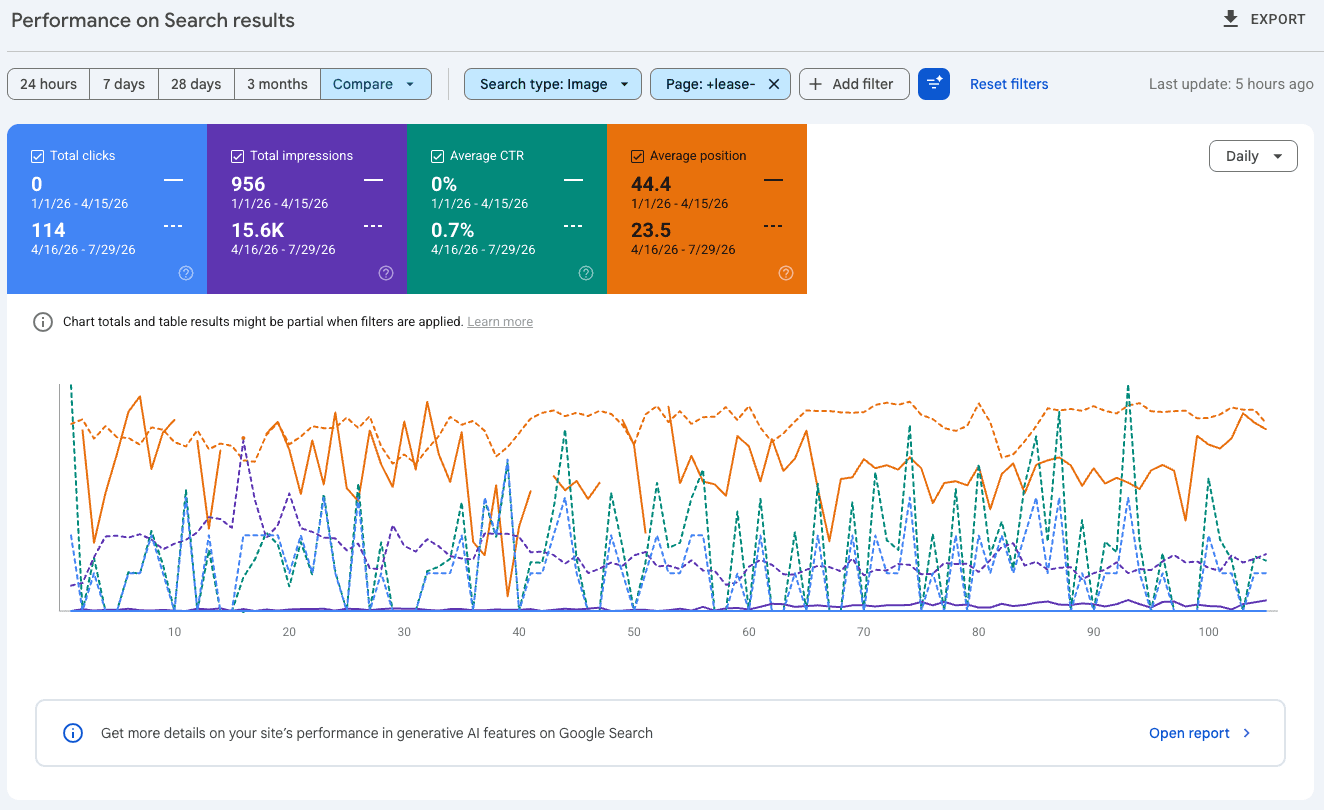
Two things happened, and only one of them is ours. We will take them in that order.
In Google Images, these pages started ranking for the searches that matter
Before the change, these lease pages had almost no presence in Google Images. What little they had was the wrong kind. They surfaced for things like "toyota rav4 rental,". Across the entire previous period they earned zero clicks.
After the change, 74 lease-related searches that had never ranked at all began ranking. Of those, 58 now sit in the top 5.
The head terms moved the most:
Search | Position before | Position after |
|---|---|---|
toyota tacoma lease | 59 | 5.5 |
toyota 4runner lease | 56 | 4.6 |
2026 toyota rav4 lease deals | 79 | 1.4 |
toyota rav4 lease deals | not ranking | 1.7 |
toyota camry lease | not ranking | 5.0 |
toyota corolla lease | not ranking | 4.7 |
toyota tacoma lease deals | not ranking | 4.6 |
The split by search type is stark. Searches with buying language in them, words like lease, deals, payment, or price, now average position 5.4. Searches without it average position 67. Every click these pages earned in Google Images came from the first group. The second group produced nothing at all.
That is worth sitting with, because it is the whole argument. Google did not simply start showing these pages more. It started showing them at the top of exactly the searches a lease shopper types.
What this means for you: the offer graphic became another lever to compete. When someone searches a lease term and Google returns a wall of pictures, a clean image with a payment on it beats a stock studio shot, and Google now knows which of your images to enter into that competition.
The Outcome on Web Search
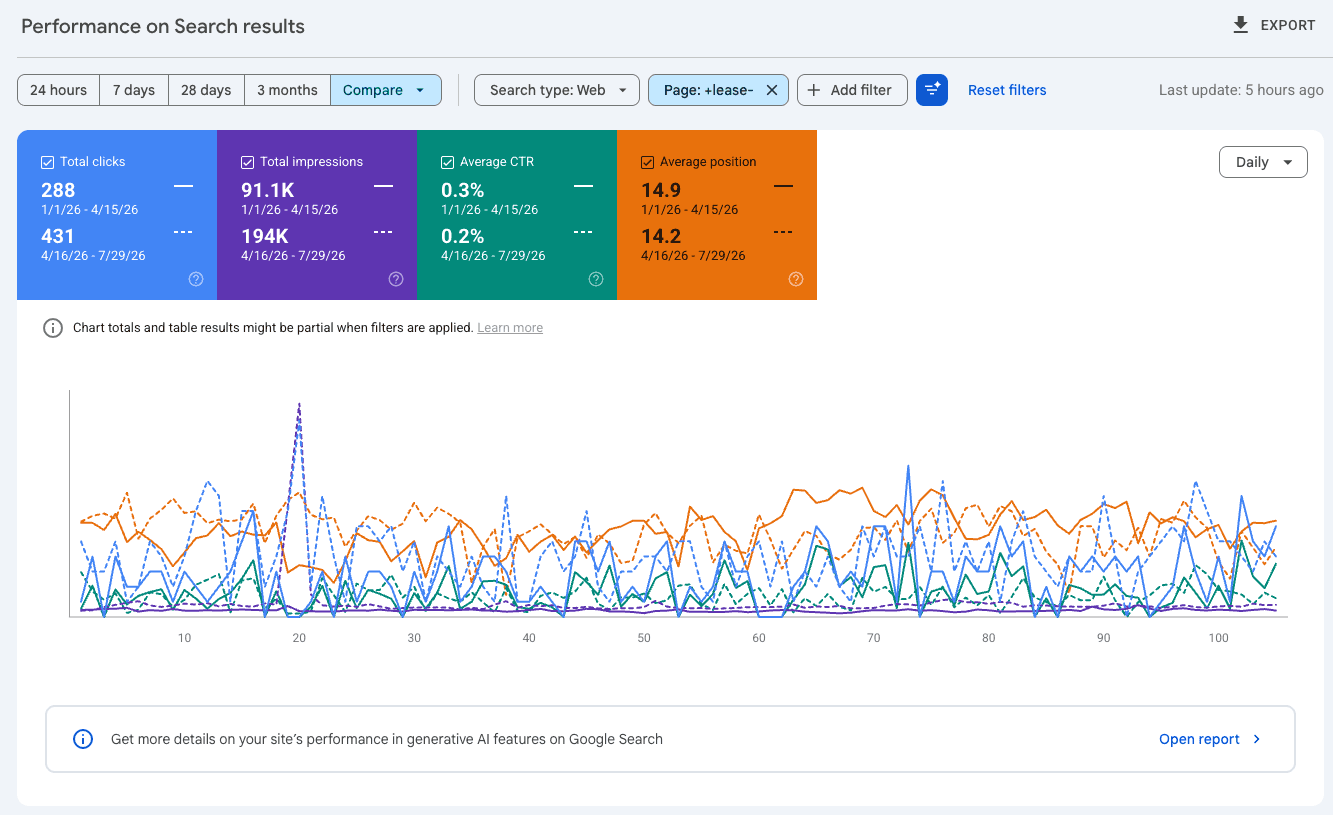
Clicks from web search rose from 288 to 431 during the testing period, and every lease page that was live in both windows gained. That is real, and we will not pretend it is nothing.
One more thing worth note: Schema
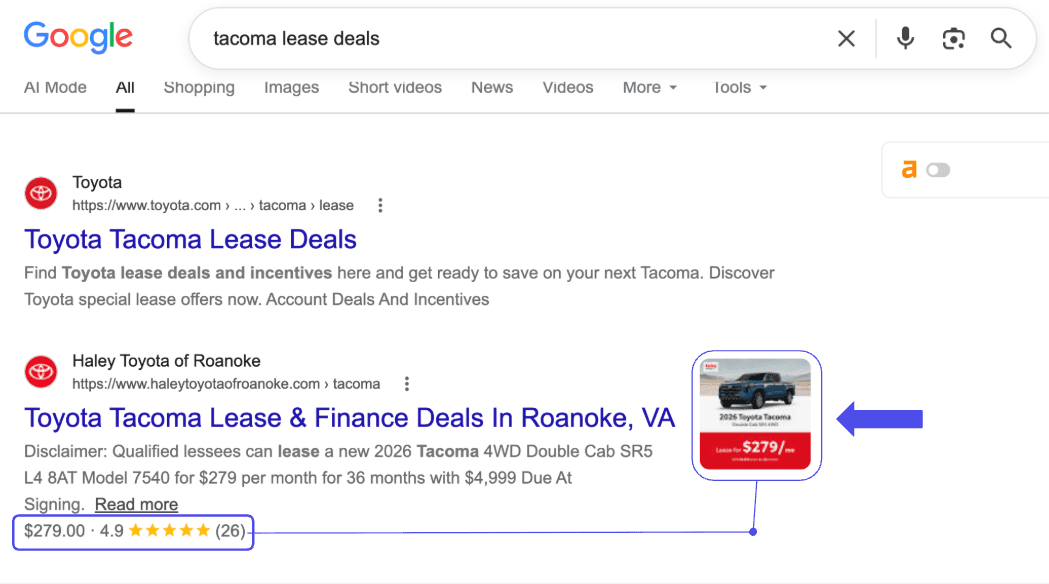
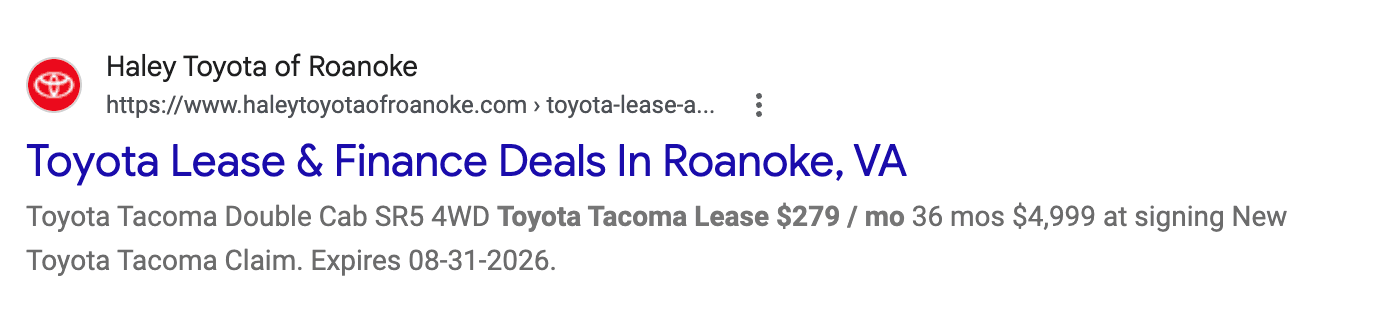
Separate from the image change, these pages also describe the lease offer itself to Google using schema. That is why the listings carry the monthly payment and a star rating right in the search result. The manufacturer's own results for the same searches often do not show that payment. Yours can.
For the nerds in the back and our nosy competitors: This page runs "OfferForLease" and “aggregateRating” schema.
Before:
After:
We outfit many of the pages we create for dealers with a variety of schema types to earn “rich results” on the search result pages, which is that little extra line of real estate in the search page. Schema controls that line of text, in this example it’s the monthly lease price and the yellow stars.
While this may seem subtle, no other competitors in the search page have it present, not even the OEM. Small subconscious changes like this influence users to click through to your website. And guess what? The more clicks that go to your website instead of options in the search results page = the higher your page ranks.
It’s a little wonder. But it’s big.
What you should know
This worked. And it is worth implementing if your store focus is heavy on lease:finance ratio.
The images need updating every month. The design has a template, so the layout stays put. But the trim, the payment, the money down, and the terms all change with each offer cycle. That is real recurring design work.
The structured data needs updating every month too. The payment written on the image and the payment described to Google have to match. When one changes, both change. Somebody has to own that, every month, without fail.
It takes a bite out of your design resources. If your design capacity is already thin, this competes directly with everything else in your marketing calendar.
For a dealership running lease offers as a core part of its strategy, that trade is worth making. If lease deals are a minor part of what you do, it may not be.
What We Are Not Claiming
A few things we want on the record, because the numbers deserve the context.
This is a before-and-after comparison, not a controlled test. We did not run a holdout group. Spring and summer are busier lease-shopping months than January through March. That seasonality is the main reason we have discounted the web search side of these results above.
These are clicks, not sold cars. Search Console measures who came to the page. What happened after that is a separate conversation, and a more important one.
The Takeaway
The lesson here is smaller than it sounds, which is usually a good sign.
Nothing was rebuilt. No new page. No new content. No new tool. Somebody read the documentation the week it changed, recognized it answered a problem the team had been chasing for a year, and pointed Google at the right image.
The result was real. On a set of searches where this dealership previously did not appear at all, it now appears near the top.
If your website pages show a random photo in search results today, that is not Google being difficult. It is an instruction nobody has given yet.
Hats off to Uran for running this one down.
Want to know what Google is currently showing next to your lease pages? We will look and tell you what we see, including when the answer is "this already looks fine."

Uran Morina
Search Analyst
Uran has worked in digital marketing for nearly eight years, more than six of them at Honest Digital. He is one of our search analysts, testing new approaches to organic growth and keeping the ones that hold up. He came to SEO from development, so he reads a site the way a search engine does. That is where his best work happens: technical audits, site health, and the code that tells Google what a page is actually about. When something is broken underneath the content, Uran is usually the one who finds it.


