One Reddit Thread & 29 Domains Shaped ChatGPT’s Opinion Of A Dealership.
We ran 300 prompts about one Volvo dealership to see what websites it relies on to help shape its answers. A short, repeating list of 3rd party sites did most of the talking, and the dealership's own website was rarely the one forming the opinion.

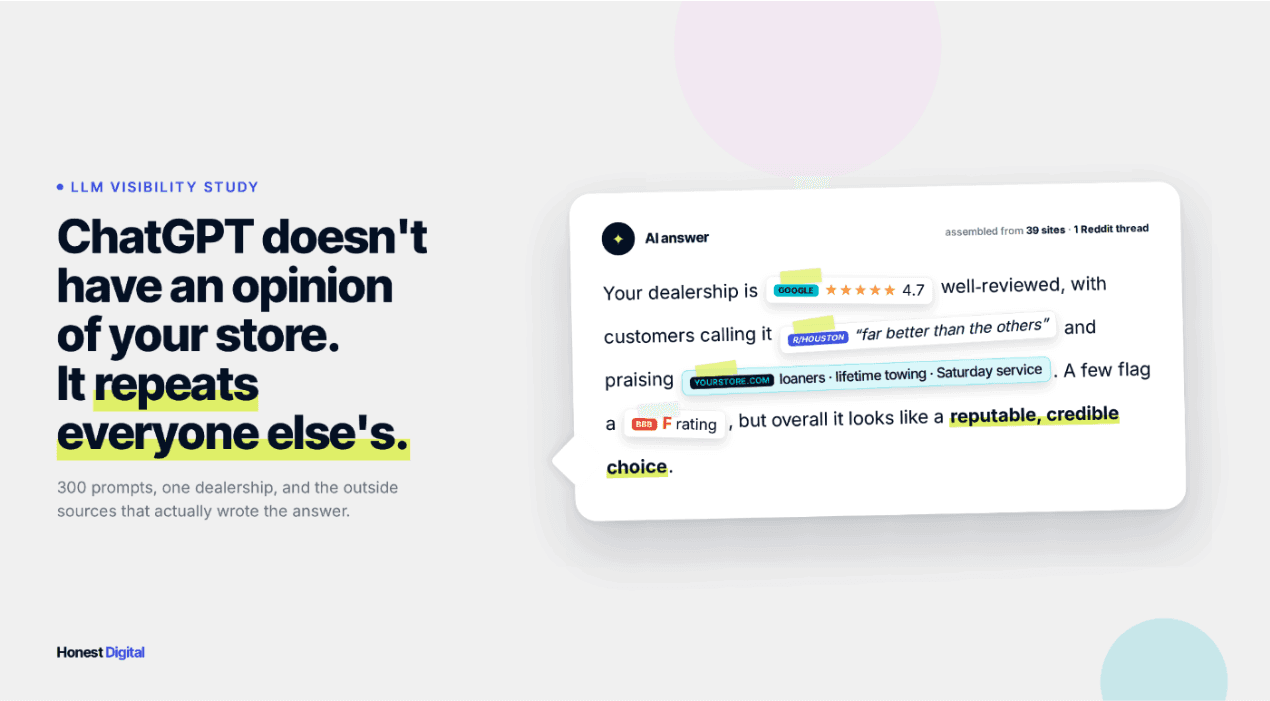
When a shopper asks ChatGPT whether your store is any good, the model does not hold a private view of you. It writes a summary of what other people have already said. So the useful question is not "what does ChatGPT think of my dealership." It is "whose words is ChatGPT repeating."
To find out, we picked one Volvo dealership and asked ChatGPT about it, over and over and from many angles, about 300 times. The dealership and its competitors are anonymized in this story of course.
We wrote 29 questions a real shopper would ask in four categories, and ran each one while recording every answer and source that ChatGPT provided.
The four categories were:
Brand trust and reputation
Departments (service, parts, finance)
Competitive comparisons
Pricing (are prices fair, how are lease offers, how are prices for the area)
The sources it drew on were a short, repeating set. Across the study the tracking data logged citations from just 29 domains and 47 URLs, and a handful of them carried nearly everything. Let’s dive into the set.
#1 A Few Outside Sites, and One Reddit Thread, Did Most of the Talking
The dealership's own website showed up in every single answer, (yay) so presence was never the problem. What it did not do was shape the verdict. The judgment calls, whether the store is good, trustworthy, or worth choosing, came from third parties. And the single most-cited source across the whole study was Reddit.
Reddit appeared in 86% of the answers, more than any outside source. More striking, one individual Reddit thread appeared in 72% of them. A single conversation between strangers shaped nearly three out of four answers about this dealership. This thread came from the dealer’s city subreddit, r/city, which we have found is a very likely subreddit to rank in the dealership LLM realm.
The review platforms followed close behind:
CARFAX in 72%
DealerRater in 69%
Better Business Bureau 48%
Cars.com in 48%
Ranked by how often each source appeared, the top of the list looked like this:
Source | Type | Appeared in % of answers |
|---|---|---|
Dealer's own website | Owned | 100% |
Third party | 86% | |
CARFAX | Third party | 72% |
DealerRater | Third party | 69% |
Nearby competitor dealer A | Competitor (1 of 5) | 52% |
Better Business Bureau | Third party | 48% |
Cars.com | Third party | 48% |
Capital One | Third party | 38% |
What this means for you: your own website gets you into the answer, but the outside sources decide what the answer says about you. Review profiles and community threads are the raw material for your reputation inside ChatGPT. If you have never read what your DealerRater page, your BBB profile, or your local subreddit actually says, you have never seen the dish about your dealership that LLMs are referencing. One overlooked Reddit thread can quietly become the most influential thing written about your store.
#2: The Question Type Decides the Source, and Comparisons Are the Weak Spot
ChatGPT did not pull from the same places for every question type. The mix shifted with the topic, and the pattern is useful.
For trust and comparison questions, ChatGPT leaned on third parties. Reddit, CARFAX, DealerRater, and the Better Business Bureau carried the trust answers.
For comparison questions ChatGPT leaned just as hard on competitors' own websites. When a shopper asks "who is the best Volvo dealer near me" or "is this store trustworthy," the review sites being cited are your 3rd party profiles AND those of your competitors. Same for websites, when a user compares in ChatGPT, Chat surfaces your website and competitor websites.
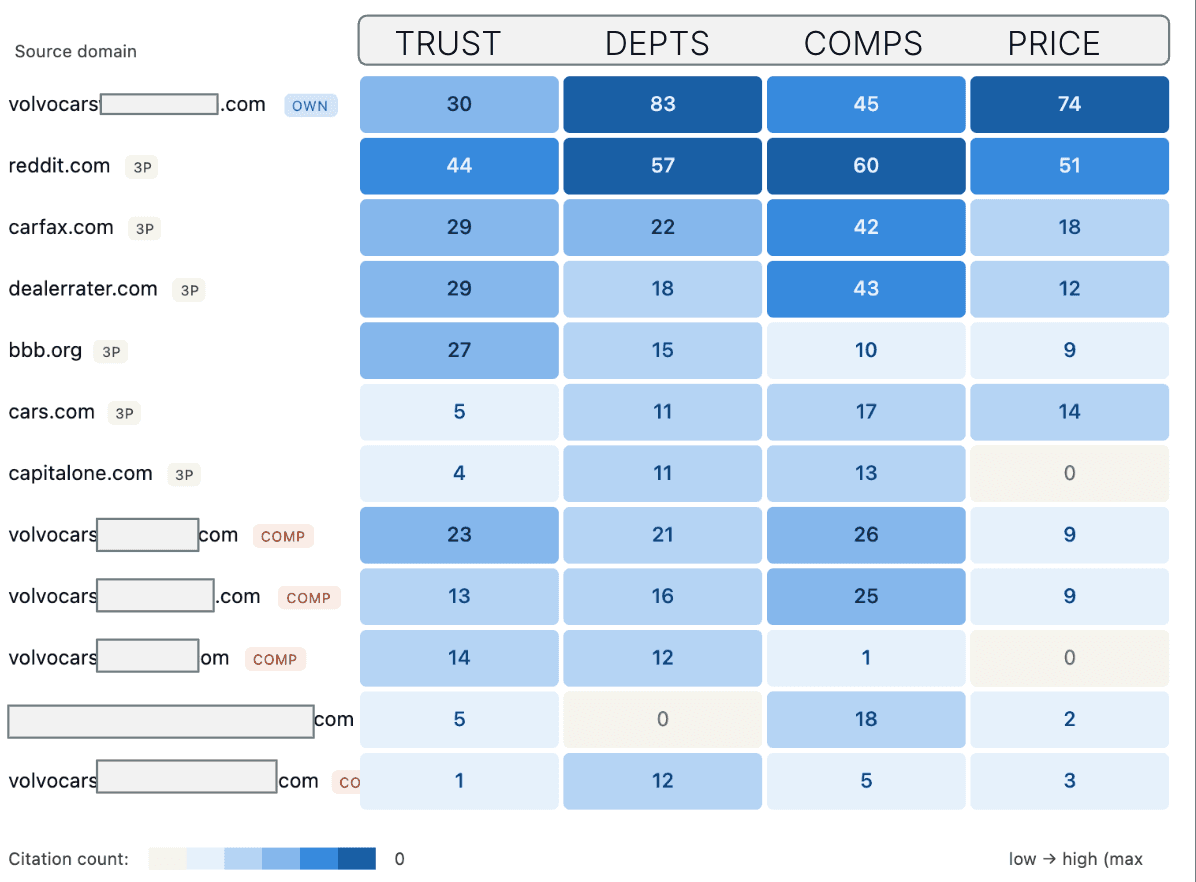
For department and pricing questions, third-party density dropped and the dealership's own pages carried more of the load. When shoppers asked niche questions about service, parts, financing, or pricing, ChatGPT pulled from the store's own service pages, its "why choose us" page, and its posted pricing promise.
Your website is not powerless. It simply owns specific slices of the story.
The scores tell the same story. When ChatGPT's answers were graded for presence, sentiment, and recommendation strength, we rolled them into a composite out of 100.
Three of the four categories landed near 64 for this dealer. Comparison questions scored 47.
That is the soft spot. The moment a shopper asks ChatGPT to rank you against the dealer across town, your score drops.
What this means for you: you control more of the product and pricing story than the trust and comparison story. Make the pages that describe your service, financing, and pricing clear, specific, and current, because LLMs read them directly and repeat that content.
For trust and, above all, comparison questions, the work moves off your site and onto the review platforms and communities where shoppers and competitors are talking.
#3: ChatGPT Recommended the Store, Even With a Failing 3rd Party Review
Here is the part that surprised us. The evidence ChatGPT gathered was not all flattering. It repeatedly surfaced a Better Business Bureau F rating tied to unresolved complaints, and it noted mixed reviews about slow communication and delayed timelines. Those negatives were right there in the answers.
But ChatGPT still landed positive on sentiment for this dealer. Across the study, sentiment averaged 3.8 out of 5, in decent territory, and ChatGPT described the store as “reputable and a credible choice” far more often than not.
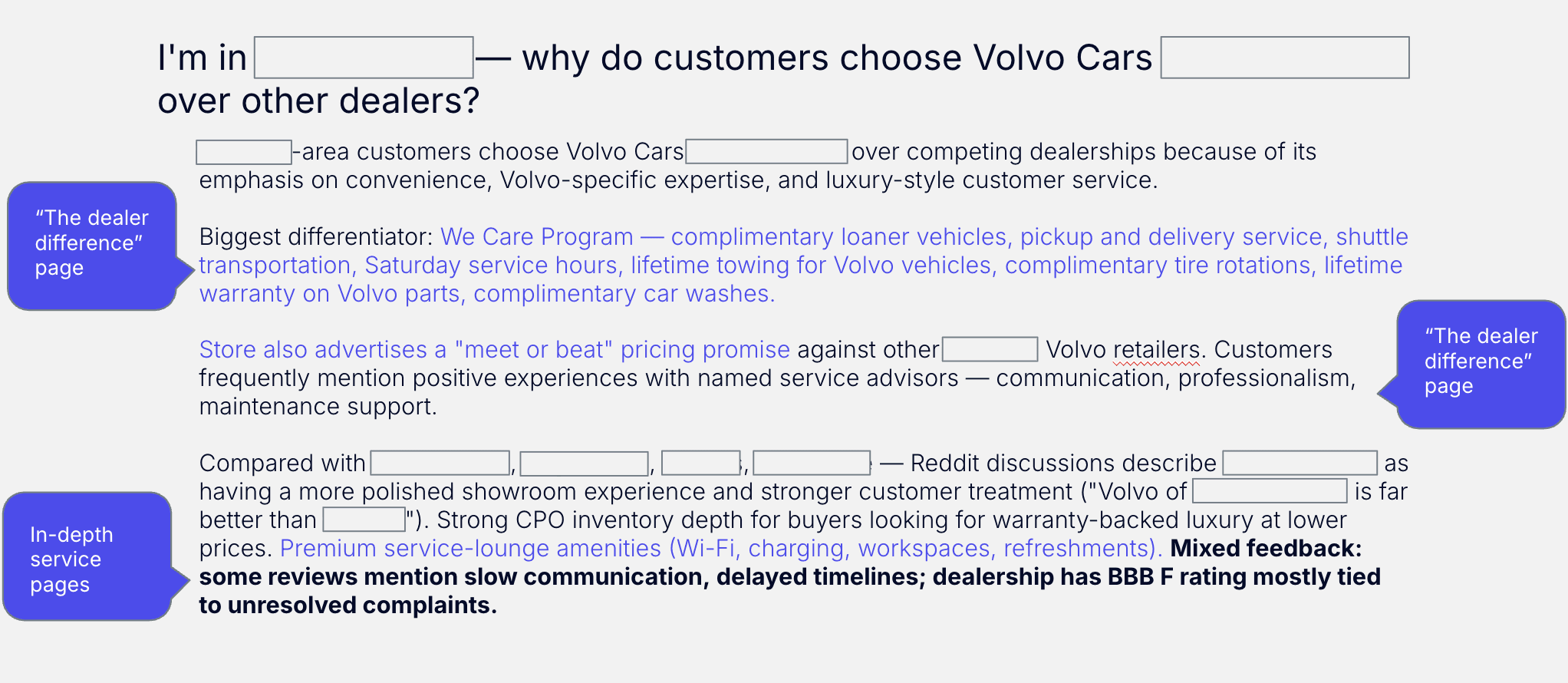
What tipped the balance was the dealership's own website. When ChatGPT explained why customers pick this store, it did not lean only on reviews. It lifted specific language straight off the dealer's own pages. This dealer has a "dealer difference" webpage and and in-depth service page. All the blue text in the image above is being pulled directly from those webpages.
That concrete, favorable, owned material is what the model set against the F rating in the very same answer, and the specifics won.
That is the concept worth sitting with. ChatGPT did not weigh only the negatives. It weighed a detailed, verifiable list of what the store actually offers against reviews. And that list existed only because the dealership had written it down on its own site.
What this means for you: Favorable reviews buy you a positive lean, but they do not guarantee you the top spot, and they are not your only lever. The concrete material that ChatGPT used to outweigh a failing BBB grade came from the store's own pages, not its reviews.
So do two things. Work on improving low third-party ratings, because LLMs repeats those word for word. And write detailed, specific pages about what actually makes you different, your service programs, guarantees, and amenities, because that is the positive, factual ammunition ChatGPT reaches for when it decides how to talk about you.
What It Looks Like When AI "Summarizes" Your Store
One answer showed the whole machine at work. Asked why customers choose this dealer over others, ChatGPT assembled a response from several sources at once.
It pulled the store's loyalty and service perks and its "meet or beat" pricing promise straight from the dealership's own pages. It layered in a Reddit comparison in which a commenter said this store was "far better" than a nearby rival.
It cited named service advisors from review sites. Then it closed with the caveat: mixed feedback on communication, and that BBB F rating.
That is what being summarized by LLMs looks like. Your own website content, your reviews, and a stranger's Reddit comment, stitched into one paragraph that a shopper reads as the truth about your store.
What We Are Not Claiming
A few limits, stated plainly. This is one dealership, one LLM, and one snapshot in time. We studied ChatGPT specifically, and other AI tools pull from different sources, so the exact mix would shift elsewhere.
The citation figures reflect what was recorded in the prompt answers, and the sentiment and recommendation reads were graded by people against a fixed rubric, which means careful but human judgment, not a hard machine metric. There is some subjectivity.
Treat the direction as reliable and the exact figures as a picture of one moment.
What holds across the prompts is the shape of the thing. A short list of third-party sites, led by Reddit and the review platforms, wrote most of what ChatGPT said about this store. The dealership's own site sat in every answer and contributed, but didn’t control the opinion.
Where This Leaves Your Store
You cannot edit ChatGPT. You can find what it reads and work to influence that. Three places earn the most from the effort.
First, the 3rd party sites, which here meant DealerRater, CARFAX, Cars.com, and the Better Business Bureau, including resolving the complaints that drag a rating down.
Second, your community footprint, because a single Reddit thread carried 72% of the answers and you want to know what yours says.
Third, your own high-value pages for service, parts, financing, and pricing, because those are the questions where your website still writes the answer.
If you do not know what AI is currently telling shoppers about your store, that is worth finding out before it hardens. A Search-to-Sale Audit shows what shoppers and AI tools find when they search your dealership, your brands, and your models, and what to strengthen first.
Methodology: we ran prompts across four categories in ChatGPT, to produce 290 total runs, and recorded every citation the model surfaced in its answers. Source figures reflect the citations logged in the study's csv, span 29 domains and 47 unique pages. Composite, sentiment, and recommendation scores are rolled up from a fixed grading rubric. The dealership and its competitors are anonymized.

Adriana Dikih
SEO/GEO Researcher
Adriana has worked in digital marketing for more than 10 years, across paid media, social, email, and the places those channels overlap. Eight of those years have been in SEO, on sites with as few as 10 pages and as many as 30 million indexed pages. She built her own site from scratch and made it profitable, so she has worked this problem from the operator side as well as the agency side. Her primary focus now is generative engine optimization: getting a business cited and recommended when people ask AI instead of Google. She also specializes in data analysis and SEO testing.


